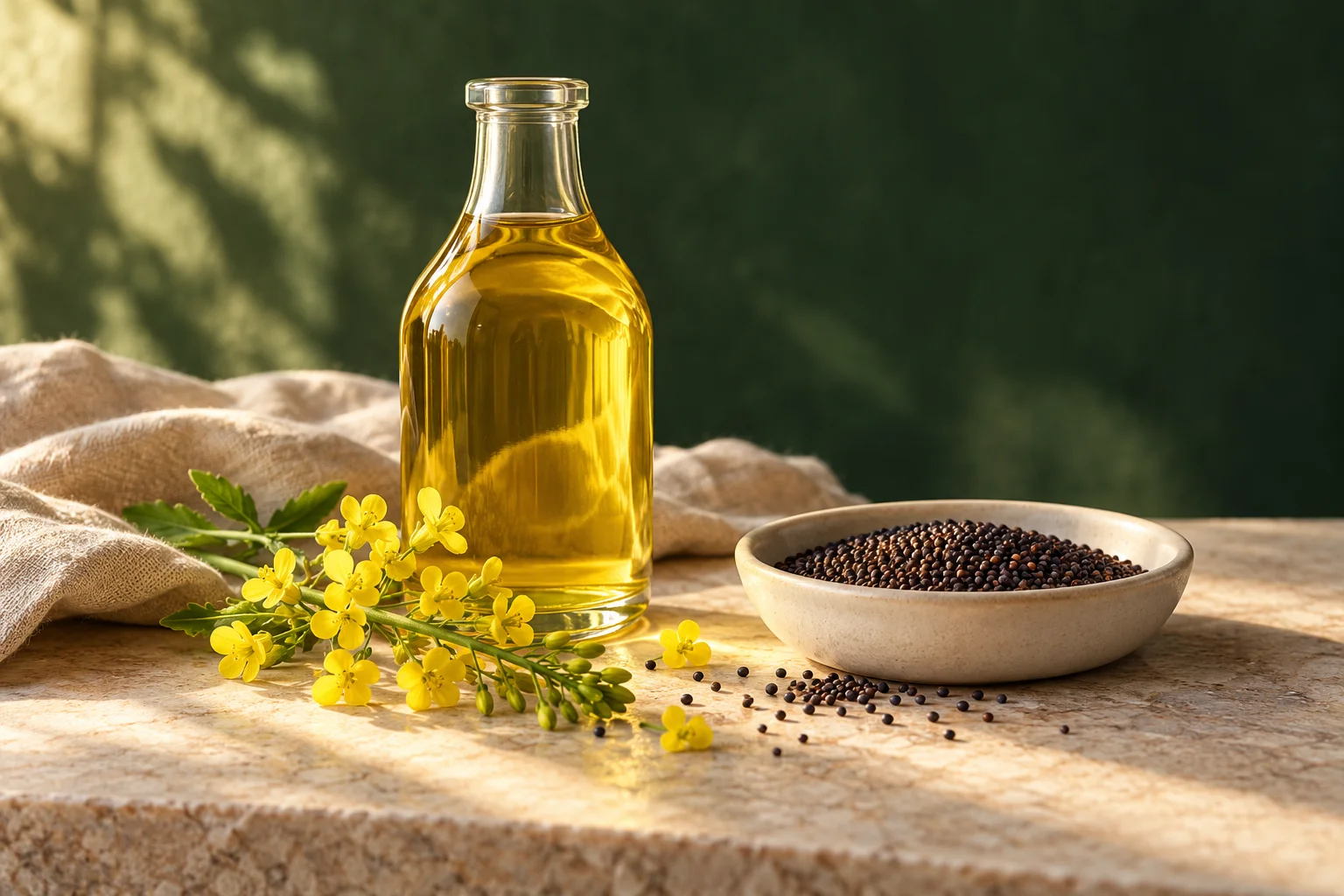
Canola begins as a tiny living seed, builds a canopy, flowers, forms pods, fills new seed, and enters a second life as oil and meal. This is the complete plant story.
Each stage creates the structure needed for the next. Understanding that sequence makes field photographs, grain-quality measurements, processing language, and food labels much easier to place in context.
01
Canola names a quality type, not a single species
Canadian canola can come from low-erucic-acid, low-glucosinolate lines of Brassica napus, Brassica rapa, or Brassica juncea.
That distinction matters because the yellow field, harvested seed, registered variety, grain delivery, and bottle of oil belong to related but different classification systems.
Brassica napus is the dominant spring canola crop across the Prairies. Other canola-quality Brassica crops exist, but a reader should not assume every yellow-flowering Brassica field or every rapeseed line is canola.
A canola seed is small, but it contains an embryo, stored reserves, and a protective coat.
The embryo includes the embryonic root and shoot plus cotyledons that support early growth. The seed coat protects the living interior during handling and storage.
Germination begins when a viable seed takes up water under suitable temperature, oxygen, and seedbed conditions. Emergence is a biological transition, not simply the passage of a calendar day.
The paired cotyledons emerge before true leaves and help power establishment.
Their shape differs from the later leaves, making them useful for recognizing a young canola plant. The growing point sits between them and produces the first true leaves.
At this stage the plant has little leaf area and limited reserves. Stand density, distribution, seedling condition, weather, soil surface, and competing organisms help describe establishment more usefully than a single field photograph.
True leaves expand around a short stem before rapid stem extension.
Leaves intercept light and exchange gases while roots explore the soil for water and nutrients. The rosette stage can look quiet above ground while the plant is building the structure needed for later reproductive growth.
Leaf number can help describe development, but plants in the same field do not always advance uniformly. Population, weather, soil, injury, and field variability remain part of the observation.
Internodes lengthen, branches develop, and flower-bearing structures rise above the rosette.
Plant height is only one visible outcome. Branching, stand density, lodging, moisture, and the timing of development help determine the shape of the canopy.
A plant-stage description should identify what is visible without turning height, colour, or apparent density into an unsupported yield prediction.
Canola's four-petalled yellow flowers open progressively on the main stem and branches.
A field can contain buds, open flowers, fading flowers, and young pods at the same time. That overlap is why flowering is a period rather than one uniform instant.
Pollination and fertilization lead toward seed development, but flower abundance in a photograph is not a direct count of final seed or harvested yield. Weather and plant condition continue to matter after petals appear.
The elongated pod is a silique containing developing seeds on either side of an internal partition.
Pod set, seed number, seed size, and retention are different components. Plants can compensate among branches and pods, so one visible component should not be read in isolation.
As seeds fill, plant resources move into oil, protein, and other seed material. Temperature and moisture during this period can influence the composition measured after harvest.
The crop moves from green, developing seed toward mature seed with a stable harvested identity.
Exterior plant colour is helpful context, but seed colour change inside pods gives a closer view of maturity. A field contains variation across plants, branches, and positions.
Harvest timing and method are farm decisions shaped by crop condition, weather, equipment, field variability, and risk. This guide explains the biology but does not prescribe a harvest date.
Seed composition links the field to the crush plant
Harvested canola contains oil, protein, moisture, fibre, minerals, carbohydrates, and other seed material.
The Canadian Grain Commission reported mean oil content of 43.6% and seed protein of 21.5% for 2025 No. 1 Canada harvest samples, both on an 8.5% moisture basis. Those are weighted harvest-sample means, not specifications for every seed lot.
Oil and protein often move in relation to genetics and growing conditions. Laboratory basis, sampling, grade, region, season, and individual lot variation must remain attached to any number.
Variety identity is governed before grain reaches the elevator
Canada's variety registration system supports identity, seed certification, traceability, and regulatory oversight.
A registered variety, pedigreed seed class, commercial grain grade, and end-product label answer different questions. Seed sold by variety name is governed differently from harvested grain moving through commercial channels.
Variety descriptions include morphological and other distinguishing information. Registration and seed certification help preserve identity, but field performance still depends on the interaction between genetics, environment, and management.
Seed condition carries field history into storage, grading, transportation, and processing.
Moisture, temperature, soundness, dockage, damage, green seed, oil content, and other measurements can influence how a lot is handled or valued. Not every field observation survives as a commercial specification, and not every specification can be inferred from appearance.
At the crush plant, oil is separated and the remaining solids become meal. The plant's biology therefore continues into two major product streams serving different customers.
The 2025 harvest-sample means below describe No. 1 Canada canola and are reported on specified moisture bases. They are not a recipe for reconstructing a seed or a guarantee for an individual lot.
43.6% oil21.5% seed proteinother seed materialmoisture, fibre, carbohydrate, minerals, and additional components; categories are not additive on one simple basis
Primary Canadian references
Biology, identity, and quality are different evidence lanes.
Plant, seed, oil and meal: four names for different parts of the story
Follow canola from a living crop to harvested seed and separated products without confusing the field with the retail bottle.
Original editorial guide · October 24, 2026
Original editorial illustration; no product endorsement or recipe test depicted.
The plant is the living crop
Canola begins as a plant growing through a season. Roots, leaves, stems, flowers and pods belong to that living crop. A flowering field is an important view of it, but it is one moment rather than the whole agricultural story. The harvested material used for oil is the seed, not the yellow petals.
This distinction is useful when looking at photographs. A landscape image can show growth, weather or field operations. It cannot, by itself, tell you the composition of the future oil, the terms of a sale or how the seed will eventually be processed.
Canola is more specific than a colour
Canola-quality material can come from more than one Brassica species. Canadian feed definitions distinguish canola seed using characteristics of its oil and solid components. The name is therefore more informative than simply saying yellow-flowered crop or treating every related plant as the same product.
For a reader, the practical habit is to keep the question precise. Are you asking about a species, a seed variety, a harvested crop, a feed ingredient or a cooking oil? The answer becomes clearer when the name of the material matches the stage you mean.
The seed is the harvested starting material
Once the crop is harvested, attention shifts to seed condition, identity, cleaning, storage and movement. Seed contains oil alongside solid material. A statement about the oil content of seed describes that starting material under a particular measurement basis; it does not say that all of that oil will arrive in a retail bottle.
Think of a sample, a seed lot and a national crop as different scales. Information from one sample can help explain that sample. A broader report needs a sampling method and appropriate definitions before its results can describe a larger population.
Oil is a separated product
Processing releases oil from the seed and prepares it for an intended use. Pressing and other extraction routes describe how separation is approached; finishing describes further work on the oil. The word oil tells you which product stream you are following, while the label and product information describe the material offered to the buyer.
A retail oil therefore has a different identity from the seed delivered to a processor. When comparing information, keep seed chemistry, processing yield and finished-product characteristics in separate columns. They are connected measurements, but they are not interchangeable.
Meal gives the solids their own story
Canola meal is a defined product made from the seed material remaining after oil removal, with its own composition and handling requirements. Canadian feed definitions also distinguish products such as canola meal protein concentrate. Meal is not a second name for bottled oil, and it is not a complete description of every solid material leaving every type of press.
Follow the words on the relevant specification. The field-to-kitchen story becomes richer when oil and meal receive their own arrows, uses and questions. One crop supports several product streams; understanding those streams begins with naming each material accurately.